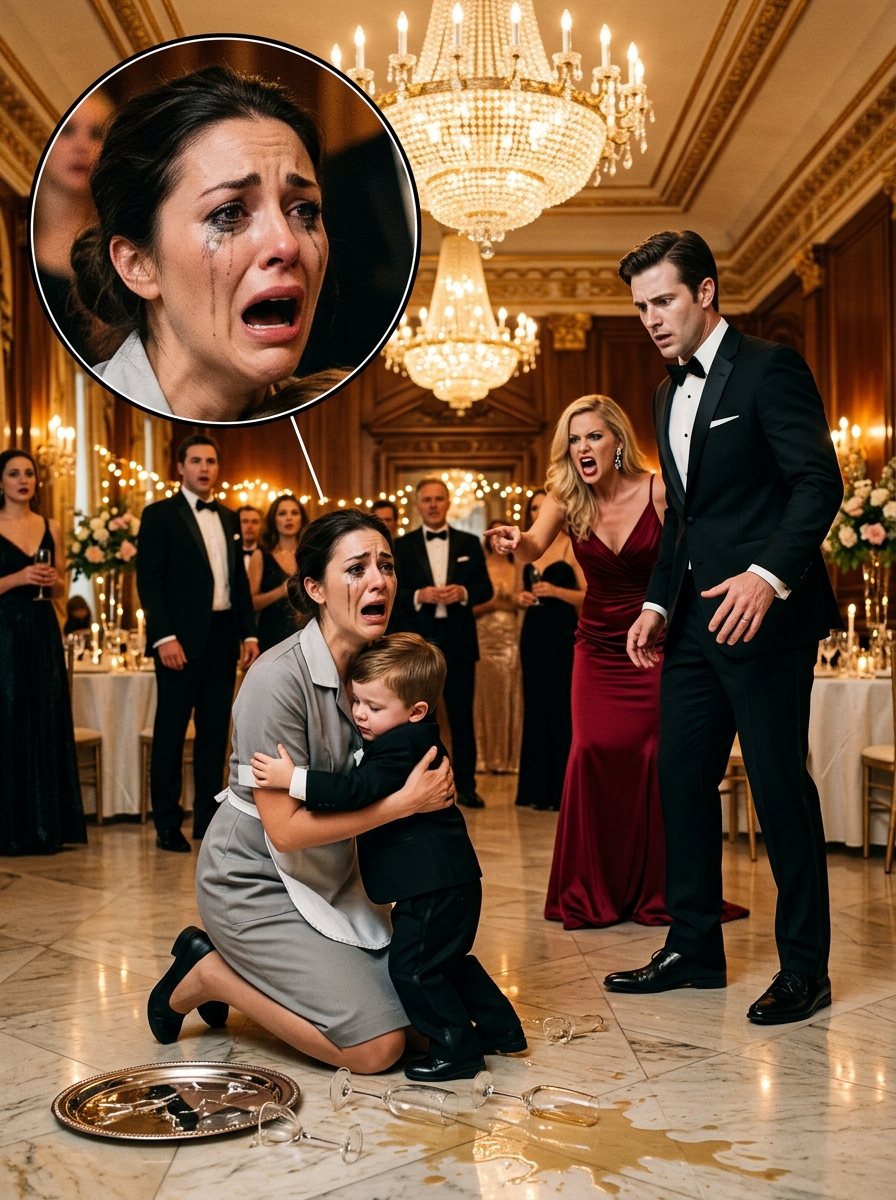
He walked right up to the crying old man and tugged gently on his sleeve, the way he had once tugged at a housekeeper’s gray uniform.
“Don’t cry, mister,” Noah said, looking up at him with those serious dark eyes. “You’re the reason my mommy came home.”
Earl looked down at the boy, and his face crumpled completely.
“You saved everybody,” Noah said simply. “You just didn’t know it yet.”
It was over supper, that long warm evening, that the rest of the story came out.
Earl lived alone now, in a small cabin by the same river that had nearly taken Clara’s life.
His wife had passed four years back. They’d never been able to have children of their own.
And this spring, the doctors had told him his lungs were giving out. A lifetime of cold mornings on the water, they said. Maybe a year. Maybe less.
“I made my peace with most of it,” Earl said quietly, his fork untouched. “But that one thing kept me up at night. That woman from the river. I needed to know she was alright before I went. I couldn’t stand the thought of dying not knowing.”
He looked around the long table, at the impossible, stitched-together family filling every chair.
“I never dreamed it was anything like this,” he whispered.
Clara reached across the table and took his hand.
“You don’t have to spend that year alone, Earl,” she said.
The old man blinked at her.
“There’s a fourth cottage,” Ethan said from the head of the table, his voice rough with feeling. “Down past the orchard, near the pond. It needs a little work. But the fishing’s good.”
Earl set down his fork with a hand that would not stop shaking.
“I can’t,” he said. “I didn’t come here for anything. I only came to know.”
“Nobody in this house ever comes for anything,” Clara said gently, the same words she had once said to Vanessa, to Frank, to Margaret. “And every one of them stayed. You gave me my whole life, Earl. Now let us give you the end of yours. Surrounded by it. By all of it.”
The old fisherman looked around the table one more time, at the children, at the mothers, at the broken and the mended, and he finally understood that he was not a stranger here.
He was the very root of it all.
Earl Whitman moved into the cottage by the pond that September.
He taught Noah and Sam to fish, the way he’d done it his whole life, patient and slow in the early morning light.
He sat on the terrace with Frank in the evenings, two old men who had each, in their own way, reached into the dark and pulled something precious back out.
And in the spring, when the daffodils came up again, the family gathered for their party on the great quilt in the garden, and the circle was wider than it had ever been.
Clara sat with Earl beside her, watching the children tumble through the grass.
“You know,” the old man said, his voice frail but content, “I always thought my life had been a small one. A quiet one. Fishing a quiet river. Loving one woman. Nothing that mattered to the wide world.”
He gestured weakly at the laughing children, at the whole stitched-together family scattered across the golden lawn.
“And then I find out one cold night I reached into the water, and all of this grew out of it.”
Clara leaned her head on his thin shoulder.
“That’s the thing nobody ever tells you, Earl,” she said softly. “You never get to see the whole shape of the good you do. One kind act, in the dark, when you think no one is watching. It spreads further than you could ever live to count.”
The old fisherman smiled, his eyes wet and shining in the spring sun.
And Clara understood, more deeply than ever, the truth the river had been trying to teach her from the very beginning.
A mother’s love does not drown.
It does not forget.
And sometimes the hands that save us belong to a stranger we will spend years trying to thank.
But love, the real kind, always finds its way back to the door.
Even if it takes a rusty old truck, and a worn newspaper clipping, and the longest road home of all.